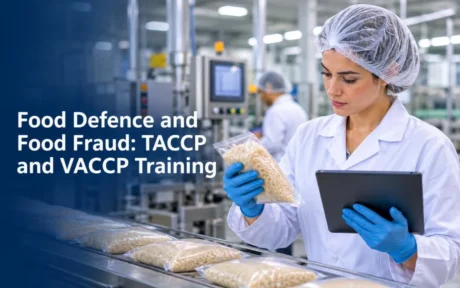
Food Defence and Food Fraud: TACCP and VACCP Training
TACCP and VACCP training for food manufacturers: food defence, food fraud vulnerability assessment, PAS 96 and BRCGS. Earn a CPD certificate.
What You Will Learn
This Continuing Professional Development (CPD) course teaches food professionals to protect their products and supply chain from deliberate attack and fraud. Every outcome links to a task on a manufacturing site, from assessing a raw material to preparing for a BRCGS audit.
- Explain the difference between food safety, food defence and food fraud, and how HACCP, TACCP and VACCP fit together.
- Identify the seven types of food crime, from adulteration and substitution to document fraud.
- Determine who might attack your products and why, including disgruntled staff, extortionists and activists.
- Conduct a threat assessment using the TACCP process set out in PAS 96.
- Conduct a food fraud vulnerability assessment of raw materials and suppliers.
- Design mitigation measures such as access control, tamper-evident packaging, supplier approval and authenticity testing.
- Assess cyber and insider threats to production systems and records.
- Apply BRCGS Issue 9 requirements for food defence and product authenticity.
- Navigate horizon scanning sources and the routes for reporting suspected food crime.
Course Overview
TACCP and VACCP training prepares food professionals to protect products from deliberate contamination and fraud, two risks a standard HACCP plan doesn't cover. Most technical teams already manage accidental hazards well, but food defence and fraud prevention need different questions: who might attack, why, and where the supply chain is weakest.
After completing the course, learners carry out a threat assessment and a food fraud vulnerability assessment, rank the risks and put proportionate controls in place. Lessons cover the motivations behind food crime, raw material vulnerability, site security and supplier approval. The course suits technical, quality, procurement and security staff who already understand HACCP. It works as food defence training and food fraud training for manufacturers, processors, packers and distributors.
Each lesson uses real cases, such as the 2013 horsemeat incident that led to the Elliott Review and the creation of the Food Standards Agency's National Food Crime Unit (NFCU). The content reflects what BRCGS auditors check and how the NFCU investigates food crime. It also covers current threats, including ransomware attacks on production systems and insiders with access to ingredients or records.
The course covers PAS 96:2017, the BSI guide to protecting and defending food and drink from deliberate attack, clauses 4.2 and 5.4 of the BRCGS Global Standard for Food Safety Issue 9, and sections 14 and 15 of the Food Safety Act 1990. Learners who pass the TACCP and VACCP training receive a CPD-accredited certificate of completion from Food Safety Training.
Ready to get certified?
About 2.5 hours of online learning. Study at your own pace and get your CPD certificate as soon as you pass.
Course Curriculum
6 lessons and a final test · about 2.5 hours in total
- 1
Food Safety, Food Defence and Food Fraud
Explains how HACCP, TACCP and VACCP differ and work together.
Video12 min - 2
Who Attacks Food and Why
Profiles attackers, from insiders to organised criminals, and their motives.
Video12 min - 3
PAS 96 and the TACCP Process
Walks through the PAS 96 steps for threat assessment.
Video18 min Conducting a Threat Assessment
Applies TACCP to a real production site.
Scenario18 minFood Fraud Vulnerability Assessment
Assesses raw materials and suppliers for fraud risk.
Scenario18 min- 6
Mitigation and Controls
Covers site security, supplier approval, testing and packaging controls.
Video15 min - 7
Cyber and Insider Threats
Examines attacks on systems, records and staff access.
Video12 min - 8
BRCGS Issue 9 and Reporting Food Crime
Links the plan to audit requirements and NFCU reporting.
Video12 min Final Assessment
Checks knowledge across all eight lessons.
Online test20 min
Sneak Peek
Lesson 1, Food Safety, Food Defence and Food Fraud (3 minutes). This clip answers the question most learners start with: if we already have HACCP, why do we need TACCP and VACCP? It compares the three using one product.
Read the lesson transcript
Imagine a factory making chicken curry. HACCP asks what could go wrong by accident. Could the chicken be undercooked? Could metal from a machine get into the sauce? It controls hazards nobody intends.
TACCP, or Threat Assessment Critical Control Point, asks a different question: who might want to harm this product on purpose? A dismissed employee could add a contaminant. An extortionist could threaten to tamper with products on shelves. TACCP looks at people, motives and access, then puts controls such as restricted areas and tamper-evident seals in place.
VACCP, or Vulnerability Assessment Critical Control Point, asks where someone could cheat for money. Could a supplier bulk out chilli powder with a cheaper colouring? Could a cheaper meat replace chicken? VACCP looks at prices, supply shortages and supplier history to find the ingredients most at risk.
All three protect the same customer, but each needs its own assessment. BRCGS Issue 9 expects sites to have a food defence plan and a food fraud vulnerability assessment alongside HACCP.
In the next lesson, you'll meet the people behind food crime and the reasons they target food businesses.
Who Is This Course For
This TACCP and VACCP training suits food professionals in 2026 who protect products against deliberate attack and fraud, as retailers and certification bodies expect documented food defence and fraud controls.
- Technical and quality managers
Maintaining the food defence plan and vulnerability assessment required by BRCGS Issue 9, clauses 4.2 and 5.4.
- Food safety team leaders
Extending the HACCP team's work to threat and vulnerability assessment.
- Procurement and supplier approval managers
Assessing raw material fraud risk under BRCGS clause 5.4.
- Site security managers
Controlling access to sensitive areas under BRCGS clause 4.2 and PAS 96.
- Production managers
Spotting signs of tampering and insider threats on the line.
- Importers and distributors
Protecting product authenticity under sections 14 and 15 of the Food Safety Act 1990.
- Food safety auditors and consultants
Reviewing clients' TACCP and VACCP assessments.
- Small manufacturers supplying retailers
Building food defence controls into customer codes of practice.
Assessment
Your result appears on screen as soon as you submit, and your certificate unlocks when you pass. The test checks knowledge and judgement only; it does not review your site's own TACCP or VACCP assessment.
Requirements
This food defence training suits learners who already understand HACCP and work in food manufacturing, processing, packing or distribution. Lessons are in English and work on any phone, tablet or computer. Most learners finish in about 2.5 hours and can pause at any point. Having your site's raw material list and current food safety plan to hand helps you apply each lesson. Content reflects PAS 96:2017 and BRCGS Issue 9 as at 2026.
This Course Includes
This TACCP and VACCP training online with certificate gives technical teams the tools to assess and control deliberate threats.
- A CPD-accredited certificate of completion, downloadable as soon as you pass
- 6 lessons with video, real food crime cases and site-based scenarios
- Coverage of TACCP, VACCP, PAS 96, BRCGS Issue 9 and food crime reporting
- Downloadable threat assessment and food fraud vulnerability assessment templates
- 14-day money-back guarantee
- Content last updated in 2026
Certification
You earn your certificate by completing all lessons and passing the final assessment. It gives auditors and customers dated evidence of food defence and food fraud training.
Career Opportunities
TACCP and VACCP training supports roles that protect food supply chains and certification.
- Technical manager
Owning the food defence plan and vulnerability assessment for BRCGS.
- Quality assurance manager
Verifying controls against tampering and fraud.
- Food safety team leader
Leading combined HACCP, TACCP and VACCP reviews.
- Supplier approval manager
Assessing supplier and raw material fraud risk.
- Procurement specialist
Buying authentic ingredients and spotting price-driven fraud risk.
- Site security manager
Controlling access to production and storage areas.
- Food safety auditor
Checking food defence and authenticity systems on audit.
- Regulatory affairs specialist
Keeping product claims and labelling accurate.
- Food safety consultant
Building TACCP and VACCP assessments for clients.
Why Choose This Course from Food Safety Training
Assessment templates aligned to PAS 96 and BRCGS Issue 9 included.
14-day money-back guarantee.
Team plans with a manager dashboard to track technical team training across sites.
Start Food Defence and Food Fraud: TACCP and VACCP Training today
Learn online on any device, at your own pace, and download your CPD certificate the moment you pass.
Frequently Asked Questions
What is TACCP and VACCP and why does it matter?
TACCP is Threat Assessment Critical Control Point, which protects food from deliberate attack such as tampering. VACCP is Vulnerability Assessment Critical Control Point, which protects against food fraud for financial gain. They matter because HACCP doesn't cover intentional threats, and retailers and BRCGS auditors expect both. TACCP and VACCP training gives technical teams the method to assess and control these risks.
What is the difference between HACCP, TACCP and VACCP?
HACCP controls accidental hazards, such as bacteria surviving cooking. TACCP controls deliberate threats from people who want to cause harm, such as a disgruntled employee contaminating a product. VACCP controls fraud risks from people who want to make money, such as substituting a cheaper ingredient. All three protect consumers, but each needs its own assessment, team input and controls within your food safety management system.
Is TACCP and VACCP required for BRCGS?
BRCGS Global Standard for Food Safety Issue 9 requires a documented food defence threat assessment under clause 4.2 and a food fraud vulnerability assessment under clause 5.4. It doesn't require the TACCP and VACCP names specifically, but these are the most widely used methods. BRCGS food defence training helps the team responsible show auditors that they understand and apply the process.
What is PAS 96?
PAS 96:2017 is a British Standards Institution guide to protecting and defending food and drink from deliberate attack, developed with the Food Standards Agency and government partners. It sets out the TACCP process step by step and gives examples of real attacks. Our PAS 96 training follows its structure, so learners can apply the guide directly to their own site.
How often should a TACCP or VACCP assessment be reviewed?
BRCGS Issue 9 requires at least an annual review, and earlier review when a new threat emerges, suppliers or raw materials change, or an incident occurs. Horizon scanning, such as FSA alerts and industry intelligence networks, tells you when to review. TACCP and VACCP training shows how to build these triggers into your system, so reviews happen before an auditor asks.
Is this course suitable for small manufacturers?
Yes. Small and medium manufacturers face the same customer and certification expectations as large sites, often with a smaller team. The course shows proportionate controls, such as simple access logs and supplier history checks, that fit a small business. It works as food fraud training for owners and technical staff who need practical steps rather than large-scale security systems.